
Tag: Responsibility

  • The difference between being wanted and being valued.

    A personal reflection on love, attraction, emotional depth, and genuine care. 

    I recently was watching a Turkish Show called “Sen Çal Kapımı”, and I fell in love with Serkan, he became my favourite thing on the show. Yes, the show followed a typical TV series trope from enemies to lovers, second change romance and memory loss, but I was still hooked. I knew it was stupid, but I was hooked. Because of Serkan. 

    Now his character was not the brightest, he had flaws a lot of them, but I loved how he redeemed himself, (and let’s be honest, I was in love with Kerem more). And that show made me reflect on myself and what I want. 

    Too deep.

    I know.

    But, I had a conversation with myself about what I want in my life, the kind of partner (if I ever get one) I would want to spend my life with. And I came to a realisation that I gravitate towards similar types of men. Emotionally available, intense, intelligent, intentional, sharp , witty and masculine men. Which is why characters like Serkan hit me so much.

    I like being valued more than being wanted. I want someone to respect me more than desire me. I want to be considered rather than just be attractive to someone. I refuse to be looked at like an object.

    I want the intensity, but I want respect too.

    I want to be desired, but I want to be considered too.

    I want attraction, but I want attentiveness too.

    There’s a huge difference between being wanted and being valued, yet people constantly confuse the two. Personally, I would choose being valued every single time. Being wanted may feel exciting, passionate, and validating in the moment, but being valued is what creates trust, stability, and genuine connection. 

    Being wanted is often tied to desire, attraction, loneliness, fantasy, or emotional need. It is connected to how someone feels around you and what you provide for them emotionally or physically. Being valued, however, goes deeper than attraction. It is about being respected, considered, appreciated, and treated with care. 

    A person can desire you deeply and still fail to treat you properly. That is the difference many people overlook.

    ✨ What Is Want?

    Want is emotional or physical desire toward someone. People are often drawn to others because they feel exciting, comforting, validating, attractive, or emotionally fulfilling. Attraction and desire are completely natural parts of human connection, and there is nothing inherently wrong with wanting someone.

    However, desire alone does not automatically create healthy love. Sometimes people become attached to the feeling another person gives them rather than genuinely appreciating who that person is. They may love the attention, comfort, validation, or emotional escape they receive without truly understanding or respecting the individual behind it.

    Want can feel intense and consuming, but intensity by itself is not proof of emotional depth. 

    🌿 What Is Value?

    Value is recognizing someone’s worth beyond what they can offer you emotionally or physically. It means appreciating them as a whole person, respecting their individuality, caring about their feelings, and treating them with thoughtfulness and consistency.

    Unlike desire, value is reflected through behavior. Someone who values you communicates honestly, respects your boundaries, supports you during difficult moments, and considers how their actions affect you. Their care is not dependent only on convenience, attraction, or emotional highs.

    While desire may draw people together, value is often what helps relationships survive beyond the initial excitement. 

    💭 Why Do People Crave Being Wanted More Than Being Valued?

    Being wanted feels emotionally powerful. It can make people feel attractive, chosen, important, and desired. That intensity creates excitement and instant emotional gratification, which is why so many people chase it.

    Society also glamorizes passionate pursuit far more than emotional stability. Movies, social media, and modern dating culture often portray obsession, jealousy, and constant longing as signs of deep love. Meanwhile, consistency, emotional maturity, and healthy communication are sometimes treated as boring simply because they feel calmer.

    The problem is that emotional intensity and emotional depth are not always the same thing. Someone can strongly desire you and still fail to respect you, prioritize you, or care for you properly. That is why desire alone is never enough. Without respect and consideration, intensity eventually becomes draining instead of fulfilling. 

    🌸 Why Should Value Matter More?

    Value matters more because it is revealed through actions rather than temporary emotions. Attraction changes. Feelings shift. Excitement naturally rises and falls over time. But the way someone consistently treats you says far more about the health of a relationship than emotional intensity ever could.

    Someone who truly values you listens to you, respects your boundaries, considers your feelings, and shows up even when things are difficult or inconvenient. They see you as a person, not just as a source of validation, comfort, or desire.

    Being wanted may give you butterflies, but being valued gives you peace, trust, and emotional security. 

    🌱 How Can People Learn to Value Respect Over Desire?

    Many people chase being wanted because they connect it to self-worth. Attention and attraction can feel validating, especially in a world where desirability is constantly tied to confidence, beauty, and social value. But eventually, people begin to realize that attention means very little when it comes without care or consistency.

    One of the healthiest mindset shifts is learning to focus less on how intensely someone feels about you and more on how they treat you daily. Instead of only asking:

    “Do they want me?”
    people should also ask:
    “Do they respect me?”
    “Do they support me?”
    “Do I feel safe, heard, and considered around them?”

    Building self-worth plays a huge role here too. People who value themselves are less likely to settle for relationships built only on attraction or emotional highs. They begin to understand that real love is not just about being desired, but about being genuinely appreciated and cared for as a whole person. 

    🚩 Choosing Better Partners

    Choosing better partners often comes down to paying attention to behavior rather than getting lost in chemistry or emotional intensity. Attraction can be powerful, but it should never be the only foundation of a relationship.

    Someone may know exactly how to make you feel wanted, but their actions will always reveal their true character over time. Do they communicate honestly? Do they respect boundaries? Are they emotionally reliable? Do their actions consistently match their words?

    Healthy relationships should bring clarity, trust, peace, and emotional stability instead of constant confusion, mixed signals, anxiety, or emotional chaos. Sometimes people mistake instability for passion simply because it feels intense. 

    Choosing better partners means prioritizing emotional maturity, communication, consistency, and mutual respect over temporary excitement or obsession.

    🤍 Conclusion

    In the end, being wanted and being valued are not the same thing. Desire may create attraction and excitement, but value is what creates trust, respect, and lasting emotional connection.

    Healthy relationships need both passion and care. There is nothing wrong with wanting or being wanted. But personally, if I had to choose between intense desire and genuine value, I would choose value every time. Because while attraction may pull people together, it is respect, consideration, and emotional care that make love last. 


  • Raised to Be Responsible: The Hidden Weight of Being the Eldest Daughter

    I was minding my own business one day when a video about eldest daughters showed up on my Instagram feed. It was an influencer talking about the struggles of being the eldest daughter. At first I scrolled past it. Then another video appeared. And another.

    Suddenly I realized something uncomfortable.

    I related to almost all of it.

    I have always felt like the man of the house. Why you might ask, I don’t know, I just feel like it. I earn money, give it to my mother and then mind my own business and let my mom run the house.

    So when I saw those videos one after another, it felt weird but relatable on a deeper level.

    But why is that? Why do I feel like that?

    Where does this “elder daughter syndrome” even start?

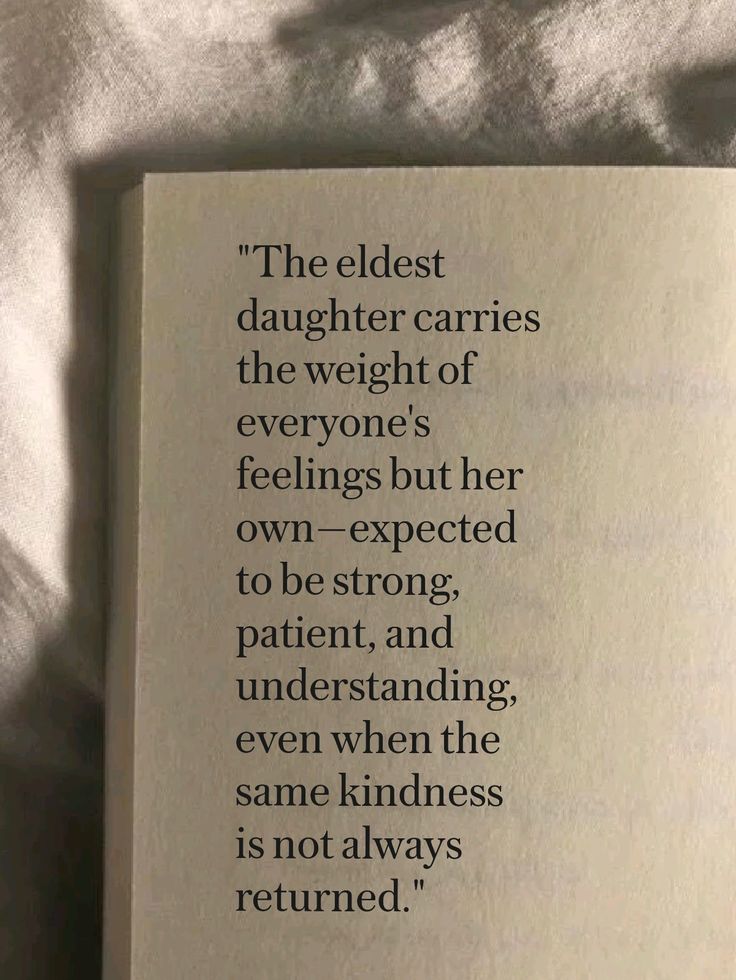
    An elder or eldest daughter is the first-born female child in a family, or the oldest daughter among siblings. She is the girl with the highest chronological age among her sisters and brothers.

    She is often viewed as a “third parent” or role model in the family and to her siblings.

    She is frequently expected to be responsible, nurturing, and emotionally grounded, acting as a caretaker for her younger siblings.

    Being the oldest female sibling in your family can have an impact on your personality and behavior. And this my friend is a universal feeling, every eldest daughter has felt growing up.

    If you had grown up as an eldest daughter, you might have felt the sense of responsibility towards your house and family that you still carry in your adulthood.

    Some Common traits people associate with it :

    Many eldest daughters report growing up as the:

    1. The responsible one

    Parents expect them to be mature early.
    Helping with younger siblings, chores, or being the “example”.

    2. The emotional mediator

    They become the person who:

    calming fights
    comforting parents
    managing everyone’s emotions

    Basically the family therapist before they’re even adults.

    3. High expectations Things like:

    better grades
    better behavior
    more discipline
    Mistakes are judged more harshly because they’re “the eldest”.

    4. Hyper-independence Because they learned early that people depend on them, they often struggle to:

    ask for help
    relax
    let others take responsibility

    5. Pressure to succeed Sometimes they feel their life choices reflect on the whole family.

    Let’s be honest I personally relate to all of it (except the best grade part, because I hated studying the most in the world, so I left that part on my sister who is a middle child and that’s a different struggle altogether), as I have felt like this for a long time. And as an adult I do struggle in asking for help. I’ve spent so many years being the reliable one that the idea of needing support feels uncomfortable.

    Part of me still believes I should be able to handle everything on my own.

    Why does this happen?

    In many cases, it’s begins with simple family dynamics.

    When people become parents for the first time, they are still figuring things out. The eldest child often becomes the learning experience. By the time younger siblings arrive, parents have already learned from those early mistakes.

    The eldest also almost always becomes a role model naturally, making your siblings follow you and that also increases responsibilities in older children.

    Why does the eldest daughter often feel more burned out than the eldest son?

    Birth order alone doesn’t explain it. The difference mostly comes from how boys and girls are socialized inside families.
    Emotional labor vs achievement pressure
    In many households, the eldest son is pushed toward external success.

    He hears things like:

    Study well.
    Get a good job.
    Take care of the family financially later.
    The eldest daughter often gets a different set of expectations.

    She is expected to manage the emotional climate of the house.

    That includes things like:

    calming younger siblings.
    helping with their homework.
    assisting the mother with chores.
    being “mature” and well-behaved.
    understanding parents’ struggles.

    The problem is that emotional labor has no clear boundaries. It never really ends.
    If your job is just to study or build a career, you can log off at some point.

    If your role is keeping everyone emotionally stable, you’re always on duty.

    That’s where the burnout comes from.
    Parentification

    Psychologists sometimes call this parentification.

    It means a child starts acting like a third parent too early.

    This might look like:

    babysitting siblings constantly.
    mediating fights between family members.
    feeling responsible for parents’ feelings.
    being the “reliable one” who cannot mess up.

    Some eldest sons experience this too. But statistically, daughters are asked to do it more often, especially in cultures where caregiving is linked to femininity.

    The “good daughter” trap

    Another subtle factor is behavior expectations.

    Girls are usually rewarded for being:
    responsible
    quiet
    helpful
    emotionally aware

    So the eldest daughter learns very quickly that love and approval come from being dependable.

    Over time, that becomes part of her identity. Even as an adult she might feel guilty if she doesn’t step in and fix things.
    That’s where the long-term exhaustion shows up.

    The bigger point

    The “eldest daughter syndrome” conversation online resonates because it captures a real pattern. Girls are often trained early to be caretakers.

    That training builds strengths like:

    emotional intelligence
    leadership
    resilience

    But it can also create adults who feel responsible for everyone else’s stability except their own.

    The healthiest shift later in life is learning that being capable doesn’t mean you must carry everything.

    How can one overcome this?

    To be honest, we all know that the “eldest daughter burnout” isn’t fixed by one trick. It usually comes from years of conditioning. You learned that your value comes from being useful, responsible, and emotionally available. That doesn’t disappear overnight.

    But it can be undone. Here’s what actually helps.

    1. Stop confusing responsibility with self-worth

    Many eldest daughters internalize this belief, “If I don’t hold things together, everything will fall apart.”

    That sounds noble, but it’s also a control illusion. Families function with or without you managing everything.

    What this really means is learning to ask yourself a simple question before stepping in.

    Is this actually my responsibility, or am I volunteering because I feel guilty if I don’t?

    A lot of burnout disappears the moment you stop adopting problems that aren’t yours.

    2. Set boundaries with family (even small ones)

    This is the hardest step because families resist it.

    If you’ve been the reliable one for years, people expect it. The moment you stop over-functioning, someone will say things like:

    You’ve changed
    You don’t care anymore
    You used to help more

    That pushback doesn’t mean you’re wrong. It means the system is adjusting.
    Start small:

    don’t solve every sibling problem
    don’t mediate every family conflict
    let adults handle their own issues

    You’re not abandoning people. You’re returning responsibility to where it belongs.

    3. Stop being the emotional sponge

    Many eldest daughters absorb everyone’s emotions. They listen to every complaint, every crisis, every frustration.

    That creates a hidden load.

    You can care about someone without becoming their emotional container.
    Sometimes the healthiest response is simply, “That sounds tough. I hope you figure it out.”

    Notice the difference. You acknowledged them without taking ownership of the problem.

    4. Build an identity outside “the responsible one”.

    This is important.

    If your identity for years was:

    The dependable one
    the strong one
    the one who handles everything

    Then relaxing feels wrong. Almost selfish.
    You need other identities too:

    writer
    friend
    athlete
    traveler
    learner.

    Your life cannot revolve only around being useful to others.

    5. Accept that people may see you differently

    When you stop over-functioning, some people will think you became colder.
    In reality, you probably just became healthier.

    A lot of women delay this step because they want everyone to remain comfortable. But growth often means someone else loses the convenience they had with you.

    That’s part of adulthood.

    Conclusion

    For many years I thought this constant sense of responsibility was simply part of my personality. Only recently did I realize it might also be the role I was trained to play as the eldest daughter.

    At its core, what people call eldest daughter syndrome is really about roles learned early in life. Many eldest daughters grow up being dependable, mature, and emotionally aware long before they are ready for that weight. Over time, those expectations can turn into pressure, and that pressure can lead to exhaustion.

    But the same experiences that create burnout also build powerful strengths. Eldest daughters often develop resilience, leadership, and deep emotional intelligence because they learned how to navigate responsibility early. The challenge in adulthood is not to erase those qualities, but to balance them with self-respect and boundaries.

    Learning to step back, share responsibility, and prioritize personal well-being allows women to keep their strength without carrying the entire emotional load of others. In the end, growth comes from recognizing that being capable does not mean being responsible for everything. True strength lies in knowing when to support others and when to protect your own energy.

    Hi, it has been a while, but I have been so busy with everything.

    I am trying to be more active from now on.

    Thank you so much for reading this far. 🤗🌷

    Do let me know your thoughts below 👇🏻💕