Tag: writers-block

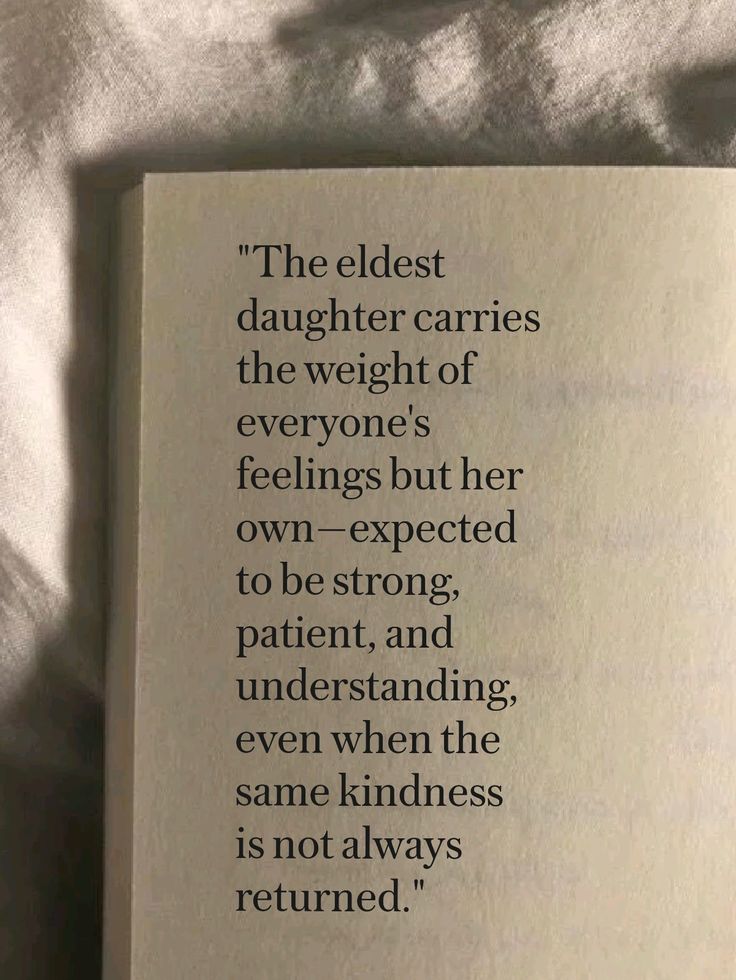
  • Raised to Be Responsible: The Hidden Weight of Being the Eldest Daughter

    I was minding my own business one day when a video about eldest daughters showed up on my Instagram feed. It was an influencer talking about the struggles of being the eldest daughter. At first I scrolled past it. Then another video appeared. And another.

    Suddenly I realized something uncomfortable.

    I related to almost all of it.

    I have always felt like the man of the house. Why you might ask, I don’t know, I just feel like it. I earn money, give it to my mother and then mind my own business and let my mom run the house.

    So when I saw those videos one after another, it felt weird but relatable on a deeper level.

    But why is that? Why do I feel like that?

    Where does this “elder daughter syndrome” even start?

    An elder or eldest daughter is the first-born female child in a family, or the oldest daughter among siblings. She is the girl with the highest chronological age among her sisters and brothers.

    She is often viewed as a “third parent” or role model in the family and to her siblings.

    She is frequently expected to be responsible, nurturing, and emotionally grounded, acting as a caretaker for her younger siblings.

    Being the oldest female sibling in your family can have an impact on your personality and behavior. And this my friend is a universal feeling, every eldest daughter has felt growing up.

    If you had grown up as an eldest daughter, you might have felt the sense of responsibility towards your house and family that you still carry in your adulthood.

    Some Common traits people associate with it :

    Many eldest daughters report growing up as the:

    1. The responsible one

    Parents expect them to be mature early.
    Helping with younger siblings, chores, or being the “example”.

    2. The emotional mediator

    They become the person who:

    calming fights
    comforting parents
    managing everyone’s emotions

    Basically the family therapist before they’re even adults.

    3. High expectations Things like:

    better grades
    better behavior
    more discipline
    Mistakes are judged more harshly because they’re “the eldest”.

    4. Hyper-independence Because they learned early that people depend on them, they often struggle to:

    ask for help
    relax
    let others take responsibility

    5. Pressure to succeed Sometimes they feel their life choices reflect on the whole family.

    Let’s be honest I personally relate to all of it (except the best grade part, because I hated studying the most in the world, so I left that part on my sister who is a middle child and that’s a different struggle altogether), as I have felt like this for a long time. And as an adult I do struggle in asking for help. I’ve spent so many years being the reliable one that the idea of needing support feels uncomfortable.

    Part of me still believes I should be able to handle everything on my own.

    Why does this happen?

    In many cases, it’s begins with simple family dynamics.

    When people become parents for the first time, they are still figuring things out. The eldest child often becomes the learning experience. By the time younger siblings arrive, parents have already learned from those early mistakes.

    The eldest also almost always becomes a role model naturally, making your siblings follow you and that also increases responsibilities in older children.

    Why does the eldest daughter often feel more burned out than the eldest son?

    Birth order alone doesn’t explain it. The difference mostly comes from how boys and girls are socialized inside families.
    Emotional labor vs achievement pressure
    In many households, the eldest son is pushed toward external success.

    He hears things like:

    Study well.
    Get a good job.
    Take care of the family financially later.
    The eldest daughter often gets a different set of expectations.

    She is expected to manage the emotional climate of the house.

    That includes things like:

    calming younger siblings.
    helping with their homework.
    assisting the mother with chores.
    being “mature” and well-behaved.
    understanding parents’ struggles.

    The problem is that emotional labor has no clear boundaries. It never really ends.
    If your job is just to study or build a career, you can log off at some point.

    If your role is keeping everyone emotionally stable, you’re always on duty.

    That’s where the burnout comes from.
    Parentification

    Psychologists sometimes call this parentification.

    It means a child starts acting like a third parent too early.

    This might look like:

    babysitting siblings constantly.
    mediating fights between family members.
    feeling responsible for parents’ feelings.
    being the “reliable one” who cannot mess up.

    Some eldest sons experience this too. But statistically, daughters are asked to do it more often, especially in cultures where caregiving is linked to femininity.

    The “good daughter” trap

    Another subtle factor is behavior expectations.

    Girls are usually rewarded for being:
    responsible
    quiet
    helpful
    emotionally aware

    So the eldest daughter learns very quickly that love and approval come from being dependable.

    Over time, that becomes part of her identity. Even as an adult she might feel guilty if she doesn’t step in and fix things.
    That’s where the long-term exhaustion shows up.

    The bigger point

    The “eldest daughter syndrome” conversation online resonates because it captures a real pattern. Girls are often trained early to be caretakers.

    That training builds strengths like:

    emotional intelligence
    leadership
    resilience

    But it can also create adults who feel responsible for everyone else’s stability except their own.

    The healthiest shift later in life is learning that being capable doesn’t mean you must carry everything.

    How can one overcome this?

    To be honest, we all know that the “eldest daughter burnout” isn’t fixed by one trick. It usually comes from years of conditioning. You learned that your value comes from being useful, responsible, and emotionally available. That doesn’t disappear overnight.

    But it can be undone. Here’s what actually helps.

    1. Stop confusing responsibility with self-worth

    Many eldest daughters internalize this belief, “If I don’t hold things together, everything will fall apart.”

    That sounds noble, but it’s also a control illusion. Families function with or without you managing everything.

    What this really means is learning to ask yourself a simple question before stepping in.

    Is this actually my responsibility, or am I volunteering because I feel guilty if I don’t?

    A lot of burnout disappears the moment you stop adopting problems that aren’t yours.

    2. Set boundaries with family (even small ones)

    This is the hardest step because families resist it.

    If you’ve been the reliable one for years, people expect it. The moment you stop over-functioning, someone will say things like:

    You’ve changed
    You don’t care anymore
    You used to help more

    That pushback doesn’t mean you’re wrong. It means the system is adjusting.
    Start small:

    don’t solve every sibling problem
    don’t mediate every family conflict
    let adults handle their own issues

    You’re not abandoning people. You’re returning responsibility to where it belongs.

    3. Stop being the emotional sponge

    Many eldest daughters absorb everyone’s emotions. They listen to every complaint, every crisis, every frustration.

    That creates a hidden load.

    You can care about someone without becoming their emotional container.
    Sometimes the healthiest response is simply, “That sounds tough. I hope you figure it out.”

    Notice the difference. You acknowledged them without taking ownership of the problem.

    4. Build an identity outside “the responsible one”.

    This is important.

    If your identity for years was:

    The dependable one
    the strong one
    the one who handles everything

    Then relaxing feels wrong. Almost selfish.
    You need other identities too:

    writer
    friend
    athlete
    traveler
    learner.

    Your life cannot revolve only around being useful to others.

    5. Accept that people may see you differently

    When you stop over-functioning, some people will think you became colder.
    In reality, you probably just became healthier.

    A lot of women delay this step because they want everyone to remain comfortable. But growth often means someone else loses the convenience they had with you.

    That’s part of adulthood.

    Conclusion

    For many years I thought this constant sense of responsibility was simply part of my personality. Only recently did I realize it might also be the role I was trained to play as the eldest daughter.

    At its core, what people call eldest daughter syndrome is really about roles learned early in life. Many eldest daughters grow up being dependable, mature, and emotionally aware long before they are ready for that weight. Over time, those expectations can turn into pressure, and that pressure can lead to exhaustion.

    But the same experiences that create burnout also build powerful strengths. Eldest daughters often develop resilience, leadership, and deep emotional intelligence because they learned how to navigate responsibility early. The challenge in adulthood is not to erase those qualities, but to balance them with self-respect and boundaries.

    Learning to step back, share responsibility, and prioritize personal well-being allows women to keep their strength without carrying the entire emotional load of others. In the end, growth comes from recognizing that being capable does not mean being responsible for everything. True strength lies in knowing when to support others and when to protect your own energy.

    Hi, it has been a while, but I have been so busy with everything.

    I am trying to be more active from now on.

    Thank you so much for reading this far. 🤗🌷

    Do let me know your thoughts below 👇🏻💕


  • Do you believe in fate/destiny?

    Do I believe in fate? Or do I just need life to make sense?

    If something bad happens, my first instinct is to tell myself it was meant to teach me something. It helps. It softens the blow. But give me a few hours and I’ll start analyzing my own choices. What did I miss? What could I have done differently? Where did I mess up?

    So clearly, I don’t believe everything is pre-written.

    But when it comes to love, I want destiny.

    I don’t want strategy. I don’t want “we met through mutual career networking and aligned life goals.” I want the cinematic moment. The unexpected connection. The feeling of “oh, this was always going to happen.”

    And that says a lot.

    Because when I think about career, money, fitness, writing — I’m practical. I know effort builds outcomes. But when I think about love, I want it to feel fated. Like some invisible thread was pulling us toward each other.

    Maybe that’s romantic. Maybe that’s naive. Or maybe it’s just human.

    I also believe some people come into your life only to teach you something. Not to stay. Not to build a future with you. Just to trigger growth. And I don’t think that’s blind destiny. I think it’s meaning-making. It’s how we survive disappointment without turning bitter.

    I think, believing in fate protects you from rejection.

    If it wasn’t meant to be, then it wasn’t about your worth. If it ended, maybe it served its purpose. That belief is soothing. But it can also become a shield.

    So do I believe in destiny?

    I think I believe in themes. Certain chapters feel bigger than coincidence. But the details? The timing? The choices? That’s on me.

    Maybe fate gives you the stage.

    But you still have to show up and act.

    And honestly, that balance feels right.

    Let me know if you believe in destiny or fate down below 👇🏻💕

    i know I have been away for a month, well my sister got married and I was busy with that. As I maid of Honor I had a lot of work to do. But now I’m back on track. I believe I will be Posting more from now on.

    see you soon again. 😁


  • What have you been putting off doing? Why

    Ohh….. A lot of things. The first is my second book. I have 2 ideas about 2 books, I am unable to choose which one I want to proceed with for now. I also don’t know where I want to put those books on. So I don’t know how I feel about all of this. Inspite of the fact that I have ideas, I am still unable to put it to practice. So I am stuck here…..

    And the other thing is my poem book, again I have ideas for all the 20 poems, but because I also have a job, I am unable to start on this too. It’s like, I have the ideas, but I don’t know how to execute it. Am I the only one why feel like this? Or does anyone else also feels like it?

    I feel like I have absolute no purpose right now, and I’m stuck in a loop, I don’t know how to get out of. I havebeen listening to BTS Sabrina Carpenter and Taylor’s new album, and that’s all I am doing. Working and listening to BTS, Taylor and Sabrina.

    But I will surely start something this Saturday on my week off.

    WISH ME LUCK!! 🤞🏻💕


  • What was the hardest personal goal you’ve set for yourself?

    Sometimes I wonder if I’m a writer or just a professional overthinker with good sentence structure 😭. Every time I sit down to write, it feels like a wrestling match between my brain, my self-doubt, and my coffee mug. I start with a fire in my chest and end up spiraling into “does anyone even care what I’m saying?” territory. Classic, right?

    Writing is the one thing that makes me feel alive — and also completely lost. It’s wild how something so personal can feel like both purpose and punishment. I want to create, I want to be read, I want to build something that matters — but half the time I feel like I’m just screaming into the void and hoping it echoes back 🌀.

    The truth is, this isn’t just about writing. It’s about identity. It’s about proving to myself that I’m capable of building something real from my thoughts. I work a corporate job, I do all the adulting, but this? Writing is the one thing that’s mine. No deadlines, no manager, no “as per our discussion.” Just me and the page — and sometimes that’s scarier than any meetings.

    I used to think the problem was time. “I’ll write when I have a free evening.” “I’ll start that story when work slows down.” Spoiler: it never slows down. The truth is, I wasn’t short on time — I was short on courage. Because writing means facing your own thoughts head-on, and that’s not always cute or convenient.

    Every now and then, I think about giving up. Packing it in. Pretending I never had this dream in the first place. But then I’ll read a line — from Austen, or JK Rowling (controversial…. I know), or even something I wrote months ago — and it hits me. That spark is still there. Faint, maybe. But real! And it deserves to be fed.

    So yes, I’m still at the starting point. Still figuring out my rhythm, my voice, my process. Still fighting that itch to edit mid-sentence like a control freak. But I’ve stopped calling it failure. It’s just the messy middle. And honestly, everyone romanticizes the beginning and the ending — no one talks about the slog in between.

    Changing habits and environments hasn’t been easy either. I’ve to make time for my hobby, and change my entire routine to manage my job and writing. I’ve had to build boundaries around my energy. Say no to things that drain me, make space for things that fill me. That’s not discipline; that’s survival. And if I want to write the way I dream of, I can’t keep pouring from an empty cup ☕.

    The hardest part? Believing that my words are worth reading. That’s it. Not the grammar, not the structure — the belief. Because when you write without validation, it’s like shouting into a storm. You have to be your own echo until someone else hears it.

    And here’s the thing — I don’t just want to write. I want to matter. I want to be remembered the way Austen is — not for her fame, but for her precision. Her truth. The quiet confidence that comes from knowing exactly who she was and writing anyway, even when the world wasn’t ready. That’s what I want. Not approval — impact.

    So, no, I’m not there yet. But I’m not quitting either. My hardest personal goal is still in motion, one word at a time. Maybe one day someone will read this and think, “Damn, she really did it.” Until then, I’ll keep showing up — messy bun, caffeine buzz, and all ✍️✨.

    Because even if no one’s reading yet, I am. And that’s enough for now.


  • From Chaos to Clarity: What Journaling and Writing Taught Me ✍️📓

    ✍️ Writing vs Journaling: How They Both Help Me

    When I first started putting words on paper, it wasn’t journaling—it was writing. I would scribble tiny poems, sometimes only a few lines long, just to capture a thought or a wave of emotion 🌊. Those little pieces weren’t perfect or polished, but they felt real. Writing gave me a way to make sense of my head when it felt too crowded.

    Journaling, on the other hand, came later. I only picked it up last year, almost by accident. I was bored, restless, and looking for a way to reconnect with myself. I didn’t plan on “becoming a journaler”—I just wanted a place to let out my thoughts. Slowly, journaling became the bridge that pulled me back into writing, and now both live side by side in my life.

    Here’s the thing: they look similar—pen, paper, words—but they serve different purposes. Writing is like reaching out; journaling is like reaching in. And both have been powerful in calming my anxiety, grounding me, and helping me grow 🌱.

    🖊️ Writing vs 📓 Journaling: What’s the Difference?

    Yes, journaling is technically writing, but the heart of each practice is different.

    ✨ Writing

    Purpose: To inform, persuade, entertain, or inspire.

    Audience: Usually external—you’re speaking to someone (even if it’s future readers).

    Format: Structured—essays, articles, poems, stories, reports.

    Process: Drafting, editing, polishing until it shines.

    Example: A blog post like this one, a novel, or even a heartfelt letter 💌.

    🌸 Journaling

    Purpose: To explore yourself—your thoughts, emotions, and growth.

    Audience: You. That’s it.

    Format: Loose, flexible, sometimes messy. Lists, doodles, bullet points, rants.

    Process: Raw, unfiltered expression. No rules, no editing.

    Example: Morning pages, a gratitude list, or venting after a stressful day 😮‍💨.

    💡 Why They Matter

    At first glance, journaling or writing might look like “just writing stuff down,” but both carry weight. They’re not chores or hobbies—they’re tools for mental clarity, creativity, and healing.

    📓 Why Journaling Matters

    1. 🧘 Clarity of mind – When your brain feels like a storm, journaling slows the chaos.

    2. ❤️ Emotional release – Writing about stress or sadness keeps it from sitting heavy in your body.

    3. 🔍 Self-awareness – You start noticing patterns: moods, habits, triggers.

    4. 🧩 Problem-solving – On paper, problems become smaller and easier to dissect.

    5. 🗂️ Tracking growth – You can look back and see how far you’ve come.

    ✍️ Why Writing Matters

    1. 🪞 Clarifies your thoughts – Writing shapes vague feelings into clear words.

    2. 📣 Communicates your voice – It’s how you’re understood by others.

    3. 📚 Preserves knowledge – Notes, essays, stories become memory-keepers.

    4. 🔥 Builds influence – Movements, laws, revolutions all began with words.

    5. 🌈 Sparks creativity – Once you start writing, ideas multiply.

    😌 How They Both Help with Anxiety

    Both writing and journaling soothe anxiety, but they do it differently:

    Journaling is inward. It’s a brain dump, a way to take swirling thoughts out of your head and trap them on the page. Gratitude journaling shifts focus from constant worry to small, grounding positives 🌼.

    Writing is outward. It channels that nervous energy into something creative or structured. Poems, stories, or even essays let you express anxiety without naming it directly.

    Here’s the subtle difference:

    Journaling processes anxiety.

    Writing transforms anxiety.

    Together, they work beautifully—journal to clear the fog, write to create meaning from what’s left.

    🌱 Where to Start if You’re New

    The hardest part is starting. We think it needs to be profound or perfect. It doesn’t. You just need to start small and keep it light.

    Beginner Journaling Tips

    🕐 Keep it short: 5 minutes, half a page.

    ✨ Try formats:

    Brain dump: write everything in your head.

    3-sentence list: Today I feel… I need… I’m grateful for…

    Prompt journaling: answer one guiding question.

    📝 Pick your medium: notebook, app, or even voice notes.

    Beginner Writing Tips

    🎯 Write about what you care about—don’t force it.

    🖋️ Set small word counts (100–200 words).

    🚫 Don’t edit while writing—let it flow, polish later.

    🎭 Experiment: letters, blog posts, micro-stories.

    📅 A 7-Day Starter Plan

    A gentle way to build the habit without pressure:

    Day 1 – Brain Dump: Write nonstop for 5 minutes.

    Day 2 – Gratitude Shift: List 3 things you’re grateful for + 1 win 🙏.

    Day 3 – Describe a Moment: Use all your senses 🌸.

    Day 4 – Anxiety Release: Write a letter to your anxiety.

    Day 5 – Story Spark: Write a memory as a short story.

    Day 6 – Self Check-In: What energized me? What drained me? What do I want more of?

    Day 7 – Free Choice: Pick whichever style felt best.

    💡 Tips for all 7 days:

    Timebox it: 5–10 minutes ⏳.

    Don’t reread right away—you’re not grading yourself.

    Keep everything in one notebook/app so your progress feels real.

    🌟 Conclusion

    Taking care of yourself doesn’t require a grand, life-changing overhaul. It’s about showing up for yourself in small, consistent ways. Every line you write, every list you make, every page you fill is proof that you’re paying attention to your inner world 💖.

    Journaling gives your thoughts a home. Writing gives them wings. One grounds you, the other expands you. Together, they become a practice of both self-reflection and self-expression—two sides of the same coin.

    And here’s the beautiful part: you don’t have to be “good” at it. Your journal isn’t an Instagram feed, and your early writing doesn’t have to be a masterpiece. The act itself is what matters. The words are less about perfection and more about presence.

    Piece by piece, page by page, you’re building a stronger, more authentic version of yourself. The kind that feels steady in uncertainty, expressive in silence, and confident in moving forward 🚀. That’s the quiet power of writing and journaling: not just tools, but companions on your path to clarity, calm, and growth.

    Let’s me know your thoughts below 👇🏻💕